
How to Search Sherburne County Criminal Dockets
The public entry point is Minnesota Court Records Online Case Search, known as MCRO. Pick Case Search. Choose the Criminal category when you know it. A full case number, a citation number, or an attorney name or bar number sharpens the results. Name searching works through person and business fields, wildcard and Sounds Like controls, and optional filters for court location, filed date, status, and category. Set the court-location filter to Sherburne when the Sherburne County criminal docket is the target.
A pending case may not surface by name. MCRO restricts defendant-name searching until conviction, so a case number, citation number, attorney search, or a call to the local court works better there. Before trusting any event title, confirm the match against the record's case number and court location. A live calendar helps spot a setting. The Register of Actions stays the chronological docket record.
- Open MCRO Case Search and select the Criminal category or enter a complete known identifier.
- Choose Sherburne County as the court location when a county-only result is needed.
- Open Case Details and compare the case type, filing date, status, and court location.
- Read Case Events, also called the Register of Actions, for the recorded sequence of filings, orders, and hearings.
- Use Sherburne County Court Administration for a current court confirmation or a certified copy when an unofficial display is not enough.
Note: A full case or citation number beats a broad name search, and it spares you the mix-ups that come with similar names.
Sherburne Criminal Docket Search Fields
MCRO groups its public tools into four areas. These are Case Search, Document Search, Hearing Search, and Judgment Search. A criminal docket search usually starts with Case Search. Hearing Search fits when you only need scheduled hearings, not the full case history. Remember that MCRO labels its record unofficial. Public documents stop at what the access rules allow. Minnesota eFile and eServe serves authorized filers, not public readers. The official MCRO Case Search interface lays out these search controls on the court's own site.
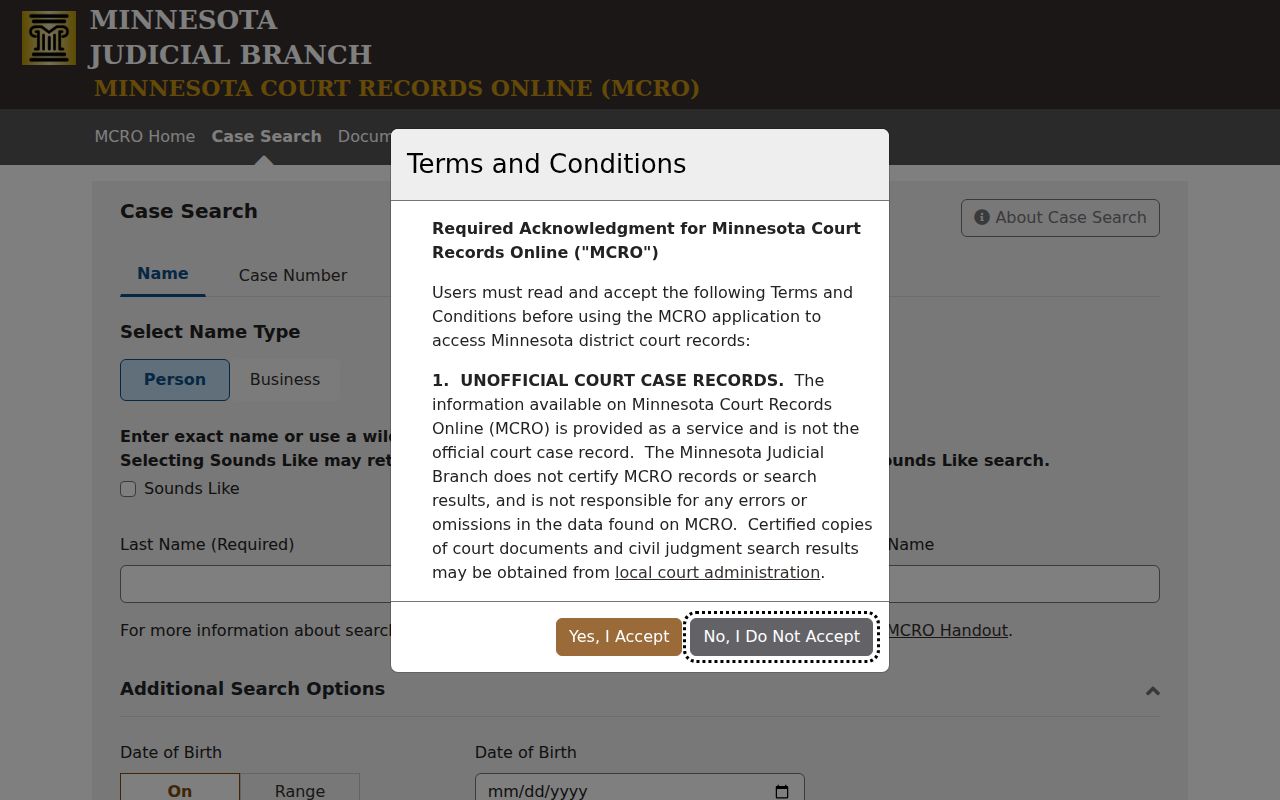
Those fields power a focused Sherburne County criminal docket search without loosening the access limits.
| MCRO route | Useful criminal docket purpose |
|---|---|
| Case Search | Find a case by permitted name variant, complete case number, citation number, or attorney. |
| Hearing Search | Check scheduled hearings by name, case number, judicial officer, attorney, date, category, or Sherburne location. |
| Document Search | Enter a complete case number to look for remotely available public documents. |
| Judgment Search | Search docketed money judgments by debtor, date, status, and location when that issue applies. |
What a Criminal Docket Shows
Case Details in MCRO identifies the case and frames the Register of Actions. Look for the court-assigned case number, case category and type, date filed, court location, judicial officer, and Open or Closed status, plus any citation number, flags, and related cases. The event area then lists activity in time order. An event may link to a public document. But an event title alone never tells you the full legal effect of an order or disposition. Read the attached filing before assuming anything.
| Case number | The court-assigned identifier. Sherburne calendar observations included criminal-style CR patterns, but not every criminal matter uses one suffix. |
|---|---|
| Case information | Case type, filing date, venue, judicial officer, status, citation data, flags, and related cases. |
| Case Events | The Register of Actions, a chronological list of filings, orders, hearings, and other recorded activity. |
| Hearings | Upcoming settings and recorded hearing activity. A scheduled label is not a final outcome. |
| Disposition and financials | Outcome or sentence information and amounts shown by the record, which must be read with the actual entry. |
Some criminal cases also show an Appear By date in Case Details. That field is part of the record, not a stand-in for checking current obligations directly with the court.
Sherburne Criminal Docket Calendar Labels
The public Sherburne calendar has carried criminal labels. Examples include First Appearance, Arraignment, Omnibus Hearing, Pre-trial, Jury Trial, Court Trial, Sentencing, Review Hearing, Probation Violation Hearing, and Intermediate Disposition Hearing. Each one names the type of setting listed for that time slot. That is all it does. A label does not establish that a hearing happened. Nor does it show that a charge was proved or a sentence was imposed. If a date or courtroom shifts, confirm with the official record or Court Administration.
- First appearance
- An early court setting that can include initial appearance and bail issues in the local process overview.
- Arraignment
- A recorded criminal stage following the court's process sequence, distinct from a final disposition.
- Omnibus hearing
- A hearing stage listed in the local criminal process sequence and on calendar observations.
- Pre-trial
- A scheduled case stage before a plea or trial, not a statement that a trial will occur.
Note: Calendar labels describe schedules only, so rely on the Register of Actions and any filed order for what actually happened.
Stages on a Criminal Docket
A local criminal hearing overview sketches the typical path. That path runs from a Rule 5 or first appearance with bail, through a Rule 8 arraignment, an omnibus hearing, pretrial activity, plea negotiation or plea, trial, and sentencing. The Sherburne County criminal docket may show each step as a setting, a filing, an order, or a later event entry. Not every case hits every stage. Court action can also shift the sequence or the timing, so treat the list as a common route rather than a fixed script.
Docket flow: Filing → Arraignment → Pretrial → Plea or Trial → Disposition → Sentencing
Keep the line between a setting and an outcome clear. A future jury-trial line is just a setting. A disposition or sentence shows up only in a later recorded event or order. For a current date, pair the Sherburne County Court Calendar with the case record. Then add the local court's confirmation.
Sherburne Criminal Docket Pretrial Context
Sherburne County's Pre-Trial Unit prepares bail studies for felony and person cases under Minnesota Statutes section 629.74. It also runs pretrial supervision, drafts presentence investigations, and connects people with chemical and mental-health resources. All of that is local criminal-case context. It does not add a second criminal court or a separate public docket. The filed criminal Register of Actions belongs to Sherburne County District Court. There, Court Administration handles records and scheduling. The court's own announcement of the 2018 Judicial Services expansion describes the expanded courthouse space. That space supports these operations.
That five-courtroom, paperless courthouse helps explain why criminal docket research in Sherburne County draws on both courthouse systems and statewide online access.
Which Court Holds Criminal Dockets
Sherburne County District Court keeps the criminal dockets for cases filed in the county. Minnesota runs one tier of trial courts. Every county has a District Court. Criminal, traffic, civil, family, probate, juvenile, and conciliation matters all move through it as case types or divisions rather than separate municipal courts. A city officer might begin an enforcement matter under a local ordinance. Once a court case is filed, though, the record belongs to the county District Court.
Court Administration is the local office behind the docket. It handles scheduling, filings, fees and fines, records, and juries. It decides nothing. Guilt, sentencing, bail conditions, and expungement belong to judges. Appeals travel the Minnesota appellate path. They are not part of Sherburne County criminal docket records just because the case started here.
Sherburne Criminal Docket Access Routes
Use the route that fits the record. Public Access Courthouse terminals give the fuller statewide electronic view when MCRO is incomplete or a certified document is needed. Paper files stay at the courthouse itself. Sherburne County Court Administration sits at 13880 Business Center Drive NW, Suite 100, Elk River, MN 55330, and answers the phone at 763-284-7140. A written request works too. Include the case name, the file number if known, the document you want, a return address, a daytime phone, and full payment by check. The county Court Administration page lays out the office's wider case-management duties. A mailed court-record request should allow five days under the Sherburne records instructions. Off-site or microfilm material can take longer. Court Web Pay may cover adult criminal, traffic, or petty cases, with payment options. It labels its own results unofficial. It also provides no electronic copies of documents.
Sherburne County Court Administration
13880 Business Center Drive NW, Suite 100
Elk River, MN 55330
763-284-7140
Monday through Friday, 8:00 a.m. to 4:30 p.m.
The Sherburne courtroom technology announcement shows how the county has long paired courtroom upgrades with its electronic-record infrastructure.
Courthouse and local-request routes still matter for those older files.
Public Access and Sealed Criminal Dockets
Minnesota presumes public access to court records. The Minnesota Public Access Rules, statutes, and case-specific orders set the real boundaries. What displays remotely is narrower than what you can inspect at the record custodian. Even a public criminal record may carry protected identifiers, withheld documents, or a remote-search limitation. Courthouse terminals give a more complete public view. No terminal defeats a seal or confidentiality rule.
Key rules for Sherburne criminal records:
Minnesota Public Access Rule 4 establishes public access subject to specified restricted categories and court orders.
Rule 8 governs inspection, copying, and narrower remote access while protecting listed identifiers.
Juvenile Delinquency Rule 30 limits remote access to public delinquency cases.
Minnesota Statutes section 609A.03 addresses expungement procedures that can restrict access.
Sherburne Criminal Docket Record Limits
An empty search doesn't prove a Sherburne County criminal docket is absent. MCRO limits pending criminal name searches until conviction. Juvenile matters stay out. So do sealed or expunged ones. Confidential data, older files, and documents outside remote coverage can also narrow what appears online. The Judicial Branch says major and minor criminal documents filed on or after July 1, 2015 are generally included, subject to restrictions and exceptions.
Don't use alternate searches to dodge an access restriction. A record can be public yet missing online. Ask Court Administration about inspection, a courthouse terminal, or the court's record-request process. Avoid copying dates of birth, home addresses, financial-account details, minor identities, juvenile names, or unredacted calendar rows. Those limits guard the line between a public court reference and indiscriminate republication.
Note: Confirm any criminal court date and required appearance directly with the court. Calendars and case records change.